

Landfill Leachate Scaling
Landfills are a breeding ground for scaling because of the decomposition of waste and the widespread presence of bacteria
Why Does Leachate Scale Form So Often in Landfill Leachate Collection Systems?
Leachate scale — primarily calcium carbonate (calcite) deposits — is one of the most common and costly operational challenges in modern landfills. It frequently clogs pipes, pumps, drainage layers, and collection trenches in leachate collection systems (LCS), leading to reduced flow capacity, increased hydraulic head on liners, potential leachate outbreaks, and higher maintenance costs.
Understanding the root causes helps landfill operators, engineers, and environmental managers implement better prevention and mitigation strategies.

Greentree Landfill: Waste-Water Treatment Plant Case Study Q&A
THE PROBLEM
“Keeping the water moving”; The biggest challenge was treating the daily leachate from the landfill plus outside liquids in a costly and efficient manner. The treatment plant is a “complex critter” that renders itself by nature due to pH needed levels in the matrix to scaling. To maintain consistent operating flow, chemicals and or manual removal of scaling was continually necessary.
A renewal NPDES permit contained new parameters which are regulated by the TMDL of the receiving discharge stream. It was immediately recognized that meeting the new limit would require significant changes to the existing chemical treatment processes and these changes would also trigger a change in the existing O&M practices.
HOW WAS SCALING AFFECTING THE OPERATIONS?
There were two types of scaling which need to be delt with. The first is in the landfill leachate collection/conveyance system. The other is scaling due to the treatment of the leachate.
HOW WERE YOU MANAGING IT?
Collection pumps were replaced, when necessary, lines were jetted as necessary in the collection system. At the treatment plant ports are installed for acid cleaning, and processes are taken offline for cleaning. Excessive down time, equipment repair, and labor was the “norm”. Descaling chemicals were added to extend operation life between down times.
HOW HAS FLOWSCIENCE CHANGED YOUR OPERATIONS?
Since the installation of the FlowScience LSC equipment, we have stopped using chemical descaling additives entirely and reduced downtime for cleaning dramatically (it was a miserable job and laborers were difficult to retain). On the high pH end of treatment cost for descaling chemical ranged from $300 to $1,300 per day depending on the volume and quality of the water treated
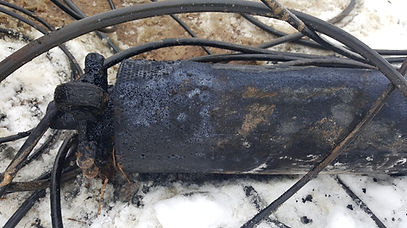
Scale Forms on Pipes, Tanks, Mixers, Pumps and Transducers


Read the Full Case Study Q&A
Why Does Leachate Scale Form So Readily on Landfills
Almost every MSW landfill generates leachate with elevated calcium, alkalinity, and microbes. Gravity-based collection systems with perforated pipes and gravel layers are inherently vulnerable to buildup in low-flow or high-nutrient zones. Without intervention, the combination leads to progressive clogging that raises hydraulic head on liners—potentially causing regulatory violations, liner stress, and even environmental releases.

Landfill environments create nearly ideal conditions for mineral precipitation. Here’s how it happens:
1. Abundant Calcium from Waste Materials
Rainwater and moisture percolate through the waste mass, dissolving calcium ions from everyday materials—construction debris, food waste, paper, and especially incinerator ash or co-disposed residues. Sites accepting ash or high-calcium waste see accelerated problems because they supply far more dissolved Ca²⁺ ions than standard municipal solid waste (MSW) alone.
2. Microbial Activity Drives the Chemistry
Anaerobic bacteria dominate the landfill’s interior. During the acidogenic and methanogenic phases of decomposition, microbes break down volatile fatty acids (VFAs) such as acetate, propionate, and butyrate. This process consumes acids, raises local pH, and increases bicarbonate (HCO₃⁻) and carbonate (CO₃²⁻) concentrations.
The key reaction looks like this (simplified):
Ca²⁺ + 2HCO₃⁻ → CaCO₃ (solid) + CO₂ + H₂OMicrobes also form sticky biofilms on pipe walls and gravel surfaces. These biofilms serve as perfect nucleation sites—tiny anchors—where minerals begin to crystallize and grow. Sulfate-reducing and iron-reducing bacteria add another layer by producing sulfides that contribute iron-based deposits.
3. Supersaturation and Physical Triggers
As leachate moves through the LCS, conditions change rapidly: pressure drops at pipe perforations, CO₂ degasses, and temperature fluctuates. These shifts push the solution past its saturation point, forcing minerals out of solution. Low-velocity zones, pipe bends, and areas affected by settlement create stagnant pockets where deposits accumulate fastest. Suspended silt and sand particles further act as seeds for crystal growth.
4. Site-Specific Accelerators
-
High organic loading in younger landfills boosts microbial activity.
-
Leachate recirculation can concentrate ions or alter pH.
-
Co-disposal of ash dramatically increases available calcium while still providing enough organic carbon for microbial reactions.
-
Warmer temperatures (from ongoing decomposition) speed up biological processes and precipitation rates.
In short, leachate scale is a natural byproduct of the landfill’s own stabilization process: mineral-rich waste + active anaerobic microbiology + flowing liquid = inevitable precipitation.
Indiana Landfill: Force Main and Sump Scaling Increasing; Costs Mounting
Scale Forms on Sump Pumps and Within ForceMain


Read the Full Case Study
THE PROBLEM
The MSW landfill had been experiencing increased precipitation of leachate scale throughout areas of the collection system and sump pumps. Formation of scaling is becoming more rapid and has reached problematic stage. Jetting is a constant battle to keep leachate flow with chemical de-scalers being a pricey option. It was a Tuesday that I saw an article on Linkedin about a “breakthrough technology for leachate scale control”. The system used a charge to treatment pads on the outside of pipes and pumps and was guaranteed to not only inhibit but also remove leachate scaling. “Highly skeptical” is a word that would best describe my thoughts on a product like this. I would have heard of it by now…
HOW WAS SCALING AFFECTING THE OPERATIONS?
Jetting wasn't keeping up. Additional measures were needed to keep critical LCS and sumps flowing. Chemical treatment was quoted several times. $300K annual was the best quote and wouldn't guarantee that jetting wouldn't be necessary in some aspects. This was going to hurt the operating budget
HOW HAS FLOWSCIENCE CHANGED YOUR OPERATIONS?
Attaching to 2 pumps that had to be cleaned almost weekly and 2 scaled lines that were in need of cleaning more frequently; we saw results in the first week. Wells and sumps were gathering a slurry and chunks of scale (much like after jetting) and the pumps look like new after many weeks of operation in the sumps. The LSC systems worked. My goal as an operator that knows the challenges of operating and MSW today is to let others know that FlowScience is completely legit and the overall benefits are tremendous. We’re greener and we’re saving costs. That’s not a common thing to have in a product.
California Landfill; 4” Force Main: Permanent Scaling Solution Project
THE PROBLEM
The Landfill was experiencing consistent scaling of approximately 2200 linear feet of the lower 4” Force Main whereas jetting was required at least twice per year. The pipe itself would be approximately 50% scaled every 6 months and continual hydro-jetting was necessary to keep the critical line flowing. In some instances, areas of pipe needed to be cut out in super-saturated calcification points. The leachate scaling itself was familiar to other sites see in California by Gii Group.
THE SOLUTION
SYSTEM 1: FLowScience LSC 2XL (4 treatment pads) to be attached to the 4” PVC pipeline immediately following the W119B location. Prior to beginning formation of scaling.
SYSTEM 2: FLowScience LSC 1XL (2 treatment pads) to be attached to the 4” PVC pipeline immediately following the W236 location.
THE RESULTS
Upon evaluation of the drawings and the FlowScience Landfill Design form Gii connected with the engineering and landfill OPS personnel to determine the solution to be provided to keep the Force Main scale free permanently. Taking under advisement the optional start-up solution, the line was jetted one more time prior to turning on the FlowScience Leachate Scale Control Systems. One system was added to the beginning of the line and another approximately 1200 feet downstream. Once systems were turned on, LF personnel would camera the line at regular intervals. In early February 2020 the landfill turned on two (2) FlowScience systems in hopes of keeping the line clear long term. As of mid November 2020, the 4” FM continued to flow freely with only minor surface scaling becoming apparent at each camera interval. It was determined in a Zoom meeting that this minor residual scaling build-up was 99% likely attributed to varying flow rates. Further camera inspections have shown the continued scale inhibiting results and as of February 2021 there has been no additional maintenance needed to keep the FM clear and FlowScience continues to inhibit leachate scaling along the line. Personnel will continue to monitor the line and have been advised that FlowScience LSC system lifespan is approximately 15 years. The FlowScience LSC Systems have worked and have eliminated the need to jet and cut the Force Main with return on investment of under 1-year.
Scale Formation Within ForceMain


Read the Full Case Study Q&A


Pulp & Paper

Brewery & Beverage

Cement

Mining
— Name, Title
FlowScience Replaces Chemicals & Jetting in These Industries Too
Additional Case Studies Available Upon Request